Observer: Three Aspects Turning Operational Modal Analysis into Decisions
The Observer Suite is your central structural and vibration analysis workspace. Digitex Systems designed it for structural and civil engineers, including researchers, to conduct Operational Modal Analysis (OMA) from measurement planning to verification of modal parameters. The Observer delivers clean visuals, automation, and clarity for confident decisions.
What Exactly Does the Observer Encompass?
Observer brings multiple tightly integrated feature pillars that are essential for many projects. Each feature is powerful on its own; in combination, they give you an end‑to‑end path from raw time histories to trustworthy mode shapes, damping ratios, and reports ready for Structural Health Monitoring programs.
1) SSI Methods (SSI‑COV & SSI‑DATA)
The Stochastic Subspace Identification is your time‑domain engine for robust modal extraction under ambient excitation. Observer automates both SSI‑COV and SSI‑DATA with practical defaults and a transparent workflow.
You’re able to choose the stabilization criteria, watch physical poles emerge from spurious ones, and retrieve frequencies and damping ratios that are resilient to noise. Stabilization diagrams, clustering, and pole filters help you lock onto consistent solutions without losing engineering control.
2) FDD Suite (FDD, EFDD, FSDD)
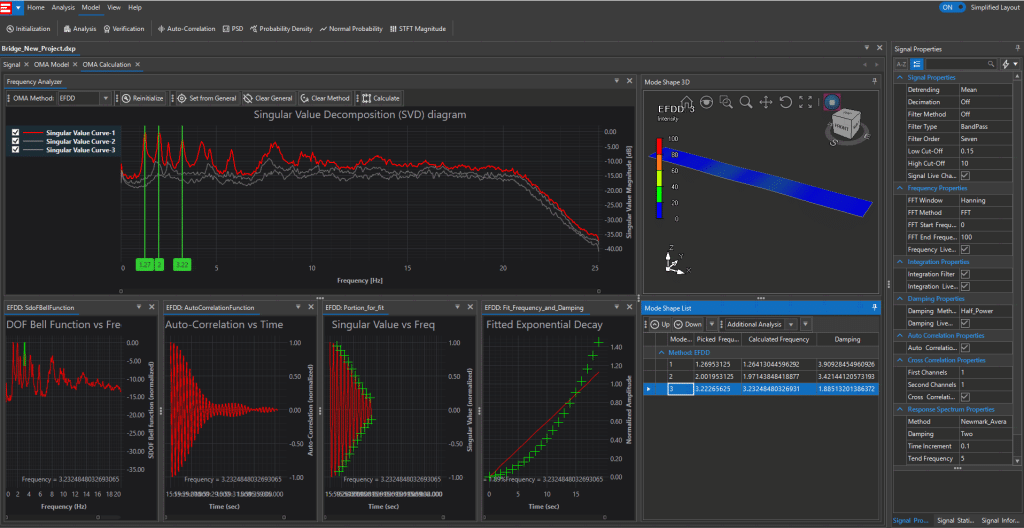
In the Frequency Domain Decomposition methods, the Observer accelerates discovery with three complementary Operational Modal Analysis methods. FDD provides a straightforward path using SVD peak‑picking on the spectral matrix, while the EFDD adds SDOF bell curves, auto‑correlation, and fitted exponential decay to estimate damping.
Lastly, the FSDD combines spatial information with frequency‑domain decomposition for cleaner mode discrimination. Combined, they support a rapid and visual route to candidate modes. This is especially useful in early campaigns and QA validation of time‑domain results.
3) Geometry & 3D Mode Shape Comparison
Observer’s 3D geometry workspace lets you model points, lines, and surfaces. On top of that, you can associate channels and animate mode shapes with rotation, zoom, and scaling.
Visual comparison quickly exposes nodal patterns, phase consistency, and local discrepancies. If you run multiple Operational Modal Analysis methods, shape inspection becomes the fastest way to confirm whether two solutions show the same physical behaviour.
Final Thoughts
Observer unifies your OMA workflow, enabling fast, visual, and defensible results. With SSI and FDD toolsets, a capable geometry viewer, and a Mac-based verification layer, you move from data to decisions without stitching multiple tools.
That’s how the Observer observes it all, establishing stable baselines, minimizing nuisance alerts, and responding early on true structural changes.