
Search
Close this search box.

The First Digitex Systems SHM Webinar

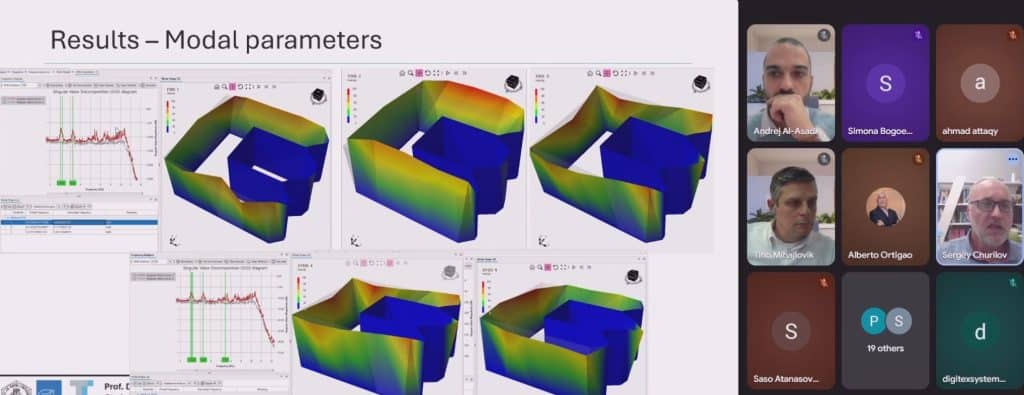
Screenshot from webinar presentation on extracted modal parameters with xWave ambient of a historical church.

Share This Post

Webinar Recap: Ambient Vibration Monitoring for Structural Safety & Efficiency

Digitex Systems would like to thank all the participants who joined our recent Structural Health Monitoring webinar! Professionals and researchers from all continents joined and fostered a valuable exchange of knowledge on AVM and modern SHM benchmark practices.

We also extend our appreciation to the Faculty of Civil Engineering in Skopje for their cooperation and academic expertise. Additionally, Digitex would like to thank the presenters, including Tino Mihajlovik from Digitex Systems. He shared practical experience from real-life monitoring projects on how advanced vibration monitoring is applied in the field.

Let’s jump in!


The Topic of the Webinar: From Sensing to Harvesting: Ambient Vibration Monitoring Applications

 
The main theme of the webinar was a real case study involving ambient vibration measurements of a historic church. More precisely, these vibration monitoring activities were carried out without structural intervention. The reason for this was the strong focus on people’s safety and also on the maintenance of the cultural heritage.
 

The Equipment

 
The monitoring setup relied on an integrated Digitex System SHM solution, aiming at high-resolution vibration monitoring. We used xWave Ambient triaxial digital accelerometers that we deployed as a wireless accelerometer network, offering 32-bit, ultra-low noise performance.
 
These condition monitoring specifications were essential for capturing low-amplitude ambient responses. The Digitex triaxial digital accelerometer xWave enabled precise measurement of structural behaviourunder everyday environmental excitation.
 

All measurement channels were managed through the xPlorer Ambient Central Processing Unit, ensuring synchronized data acquisition and processing. This synchronization was essential for reliable modal identification and consistent long-term structural health monitoring results.

The Software

During the measurements, Voyager‘s real-time streaming and monitoring software provided live access to data, system status, and sensor performance, supporting both on-site and remote supervision. The recorded datasets were subsequently put into and analyzed using Observer Operational Modal Analysis software, which extracted dynamic properties such as natural frequencies and mode shapes for structural assessment.

This workflow illustrates how modern structural health monitoring systems can deliver accurate, non-invasive insight into structural performance. By combining wireless sensing, synchronized acquisition, real-time monitoring, and advanced analysis, ambient vibration measurements become a practical tool for informed engineering decisions and improved safety of existing structures.
 

Our special thanks go to…

We would also like to express our special thanks to civil engineering professors Sergey Churilov and Simona Bogoevska from the Faculty of Civil Engineering in Skopje. Their topics were:
 
  • Non-destructive Dynamic Characterization of Medieval Structure: Church of St. Bogorodica, Macedonia (Prof. Dr. Sergey Churilov);
  • Vibrations Over Time: Data-driven Diagnostics and Forecasting for Real-World Civil Infrastructure. (Prof. Dr. Simona Bogoevska)
 
Their presentations on ambient vibration testing and operational modal analysis of historic structures formed the technical foundation of the event, combining academic rigour with real-world application. 
 
Their expertise, preparation, and close collaboration were the key to sparking interest and deeply professional discussions. Till the next time!

More To Explore

Screenshot from webinar presentation on extracted modal parameters with xWave ambient of a historical church.
Blog

The First Digitex Systems SHM Webinar

Webinar Recap: Ambient Vibration Monitoring for Structural Safety & Efficiency Digitex Systems would like to thank all the participants who joined our recent Structural Health
