
Why Time Synchronization Matters in Structural Health Monitoring
A bridge, dam, building or tower does not vibrate at only one point. When wind, traffic, machinery or ground motion excites a structure, different sections move at the same time—but not necessarily in the same direction or with the same amplitude.
To understand this behaviour, engineers commonly install accelerometers at several locations. However, collecting accurate vibration data is only part of the task. The measurements must also share the same time reference.
What Is Sensor Synchronization?
Sensor synchronization means that every measurement channel records the same moment simultaneously.
Imagine two accelerometers installed on opposite sides of a bridge. If one sensor records a sample slightly earlier than the other, the software may interpret that delay as a real difference in structural movement. When many sensors are used, timing errors can distort the relationships between the recorded channels.
For simple vibration-level monitoring, a small timing difference may not always be obvious. For Operational Modal Analysis, however, synchronization is essential because the analysis compares how multiple measurement points move together.
Why Timing Matters for Modal Analysis
Operational Modal Analysis, or OMA, uses vibrations produced during normal operation of a structure. Wind, traffic, machinery and human activity can provide the necessary excitation, meaning that a large external shaker is generally not required.
From synchronized acceleration measurements, especially for wireless accelerometers, OMA can estimate three important modal properties:
- Natural frequencies: The frequencies at which the structure tends to vibrate.
- Damping: How quickly its vibration decreases.
- Mode shapes: How different parts of the structure move relative to one another.
Mode shapes depend strongly on the amplitude and phase relationships between sensors. Published research has shown that timing differences between distributed accelerometers can produce inaccurate modal parameters, particularly incorrect mode shapes. When channels are not properly aligned, part of the physical relationship between the measurement points can be lost.
From Separate Sensors to One Structural Picture
A single accelerometer describes motion at one location. A synchronized network creates a wider picture of the complete structure.
For example, sensors positioned along a bridge deck can show whether different sections move together, in opposite directions or with different amplitudes. Sensors installed on several levels of a building can show how vibration changes from the foundation to the upper floors.
Synchronization is therefore not simply a communication feature. It is part of the measurement quality. Accurate timing allows analysis software to process data from multiple sensors as one coordinated structural recording.
How Digitex Equipment Supports Synchronized Monitoring
Digitex Systems designed the xWave digital accelerometer platform for distributed vibration monitoring. Multiple xWave triaxial digital accelerometer units can be installed at selected positions and synchronized through GPS-based timing or the DigiSync network synchronization protocol.
For temporary measurements, xWave Ambient sensors can be used together with the portable xPlorer Ambient acquisition unit. This allows engineers rapid deployment of a synchronized digital wireless accelerometer sensor array for ambient vibration measurements, modal testing and periodic structural assessments.
For permanent installations, xWave units can continuously record and stream synchronized data to Voyager. The software stores, displays and manages the measurements, while Observer and Voyager OMA Intelligence can process selected data periods and calculate natural frequencies, damping ratios and mode shapes.
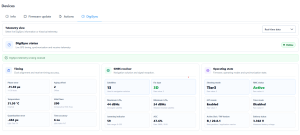
Digitex DigiSync Proprietary Synchronization Protocol
Voyager OMA Intelligence can also store repeated analysis results, compare modal behaviour with an approved reference condition and display historical changes. This helps engineers evaluate structural behaviour over time instead of relying on one isolated measurement.
Reliable Timing Creates More Reliable Information
High sensitivity, low sensor noise and correct installation are all important in structural vibration monitoring. However, when measurements from several locations must be compared, precise synchronization is equally important.
Synchronized accelerometers allow engineers to understand not only how much a structure moves, but also how its different sections move together. Combined with suitable analysis software, this transforms separate vibration signals into useful information about the dynamic behaviour of bridges, dams, buildings, towers and other critical infrastructure.
For Digitex Systems, synchronization connects the complete monitoring chain—from xWave measurement and xPlorer or Voyager acquisition to automated OMA analysis and long-term structural interpretation.