Vibrations We Can’t Feel: How a High-Sensitivity Accelerometer Can Reveal Structural Motion
On a quiet night or a calm day, it may appear completely still. But that’s only for our eyes! In reality, every structure, especially a civil structure, is continually responding to the effects of its surroundings.
Wind, traffic, machinery, footsteps, temperature changes and small ground motions can create vibrations that are often far below the threshold of human perception.
In this article, we’ll dive deeper into the relationship between high-sensitivity digital accelerometers and the detection of structural motion.
Every Structure is Constantly Moving
Not every structural motion indicates a problem. Civil engineers expect bridges and buildings to move slightly under normal environmental and operational loads. What mostly matters is how the structure responds to these effects, and whether that response remains stable or its behaviour changes over time.
Even very weak motion can contain useful information for civil engineers, dam operators, mining companies, or building managers. Specific structures tend to respond more strongly at particular natural frequencies and through specific mode shapes.
A comprehensive SHM system for civil infrastructure can determine these properties, together with the damping, to form a dynamic signature for measuring and comparing.
What’s The Use of High-Sensitivity Accelerometers
Ambient structural vibrations can be extremely small. This is true especially in stiff civil infrastructure. A conventional accelerometer will hardly distinguish these signals clearly from its own internal noise.
The purpose of high-sensitivity digital accelerometers is to resolve weak acceleration over the low-frequency ranges, which is essential for structural monitoring.
Important measurement characteristics include:
- Low self-noise: To overcome weak structural motion hidden by the sensor itself.
- Good low-frequency response: For overcoming the main challenge of slow vibration of large structures.
- High-resolution digitization: For accurate recording of small signal variations.
- Reliable synchronization between sensors: For motion comparison at different locations.
- Stable installation and mounting: Poor installation can distort the recorded response.
From Tiny Signals to Modal Information and Analysis
Vibration monitoring while a structure remains in normal operational service can be very helpful for Operational Modal Analysis. Civil engineers and companies can install high-sensitivity digital accelerometers at several locations, for example along a bridge deck or across building floors.
Moreover, the system precisely synchronizes the measurements from different locations. Traffic, wind, machinery, or increased human activity provide the excitation. So, engineers don’t need shakers as in the old days.
The SHM software compares the frequency content and phase relationships between channels to identify natural frequencies, damping ratios and mode shapes. These parameters show how strongly the particular structure vibrates. Also, it shows how quickly motion decays and how different areas move together. Repeated and real-time measurements can reveal changes in structural behaviour over time during defined operations.
How Digitex Equipment Supports the Measurement
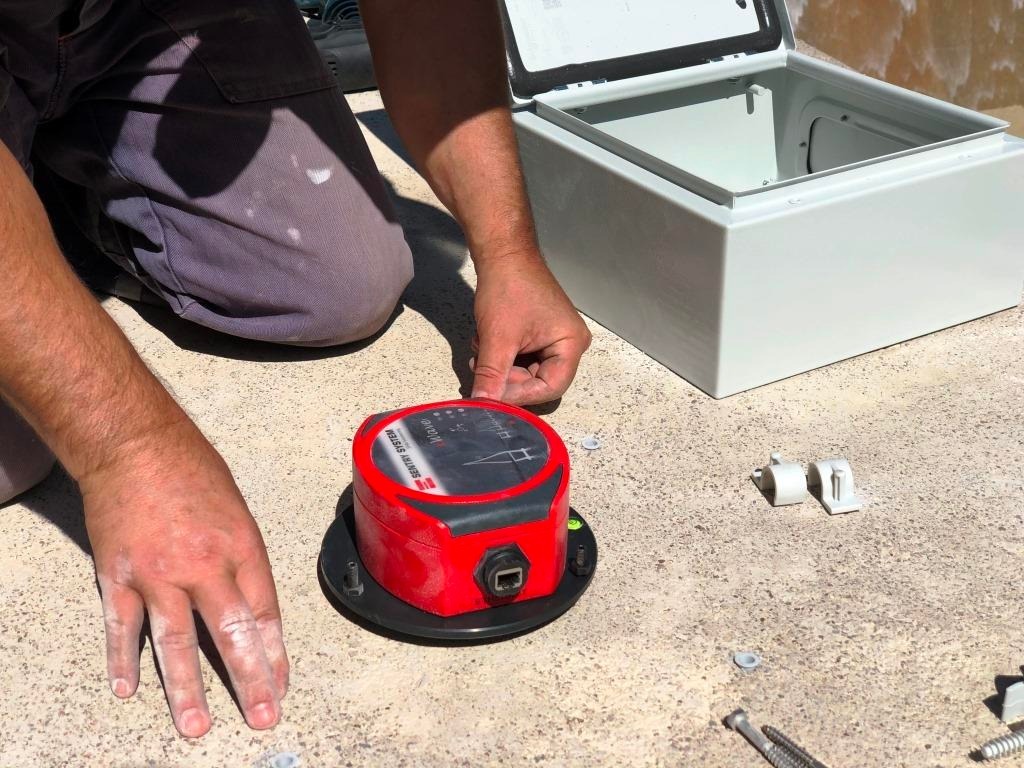
Digitex Systems provides a comprehensive measurement and analysis solution for weak structural vibration. That’s why Digitex designed the xWave platform specifically for synchronized, triaxial digital accelerometer measurement.
That’s why our high-sensitivity xWave digital accelerometer configuration is intended to resolve low-level ambient motion challenges. On the other hand, the xWave Ambient, a wireless triaxial digital accelerometer sensor, can be deployed at multiple points across a structure when the configuration demands a highly sensitive wireless solution.
A typical Digitex Systems workflow can include:
- xWave high-sensitivity digital accelerometers recording structural motion in three different axes.
- xPlorer Ambient providing portable acquisition for temporary investigations and modal testing.
- Permanent xWave installations continuously storing and streaming data as part of an SHM network.
- Voyager OMA Intelligence estimating and tracking frequencies, damping, mode shapes and modal correlations.
Why Long-Term High-Sensitivity Monitoring Can be Crucial
A change in natural frequency does not automatically prove that there’s damage in the particular structure. Temperature, humidity, traffic intensity, or water can also influence the structural modal properties. That’s why long-term monitoring creates a baseline and helps engineers separate normal environmental variation from persistent or unusual structural change.
Digitex Systems Are Making Invisible Structural Behaviour Measurable
High-sensitivity accelerometers allow civil engineers, dam operators or business managers to observe structural motion that people cannot see or feel.
In combination with synchronized acquisition, Operational Modal Analysis and historical trending, these measurements provide a clearer picture of the structural behaviour and its changes over time.
In this manner, Digitex Systems is always striving to provide engineers with a complete set of tools, along with high-sensitivity accelerometers, for this purpose.