What is Intelligent Alarming?
Effective alarming in Structural Health Monitoring is not only about detecting high values. It is about identifying abnormal behaviour. Furthermore, reducing false alarms and ensuring that every warning leads to a clear response. These principles are central to an established alarming system.
1. Thresholds should detect abnormal behaviour
A high value is not always abnormal. Vibration may increase because of traffic, wind or machinery operation, while strain and displacement may change with temperature or variations in loading.
Digitex SHM systems allow users to configure alarm limits for the relevant sensors and channels using appropriate software. Depending on the application, the alarm can be based on minimum or maximum values, relative changes, event-detection logic, STA/LTA or OMA-related results. This allows the alarm configuration to follow the monitored structure and measurement type.
2. Alarms should lead to action
A useful alarm must clearly indicate that attention or intervention is required.
Through the Voyager software in combination with the xAlarm, a detected condition can:
- Send SMS or email notifications
- Activate a siren or warning light
- Trigger a relay output
- Stop machinery or activate another protection system
- Preserve the corresponding event data for extra analysis
- Automatic generation of PDF reports
This connects the complete workflow: measurement, detection, notification, response and analysis.
3. False alarms must be controlled
Short disturbances, environmental changes, unsuitable thresholds or poor-quality measurements – any of these can cause a False Alarm.
Digitex reduces this risk by using application-specific trigger logic together with precise and synchronized measurements from multiple sensors/channles. Engineers can configure one or more intelligent alarm configurations/mechanisms that will be activated only on relevant conditions.
For OMA monitoring, available in the Voyager OMA Intelligence, repeated modal results and MAC comparison can also help confirm whether an observed change is stable and meaningful.
3. Operational Modal Thresholds Can Provide Earlier Warning
Fixed thresholds detect when acceleration, strain or displacement exceeds a defined limit. However, changes in a structure’s dynamic characteristics may become visible before these limits are reached.
Research on automated modal anomaly detection demonstrates how thresholds applied to tracked modal parameters, including natural frequencies and damping ratios, can identify abnormal structural behaviour.
This principle is directly relevant to Voyager OMA Intelligence. Repeated OMA results—such as natural frequencies, damping, mode shapes and MAC values—can be compared with a verified reference condition. A persistent change beyond configured limits can generate an OMA-based event and activate the required Voyager and xAlarm workflow.
Such a trigger does not automatically confirm structural damage. It provides an early indication that the structure’s dynamic behaviour has changed and requires engineering review.
5. Reliable alarms require reliable data
Alarm quality depends directly on sensor quality and installation.
The selected sensor must provide suitable:
- Sensitivity
- Noise performance
- Measurement range
- Bandwidth
- Dynamic range
- Calibration accuracy
A threshold set close to the sensor noise level may create unstable alarms, while a sensor with insufficient sensitivity may miss small but important changes. Correct sensor quality, installation, synchronization and continuous data availability are therefore essential.
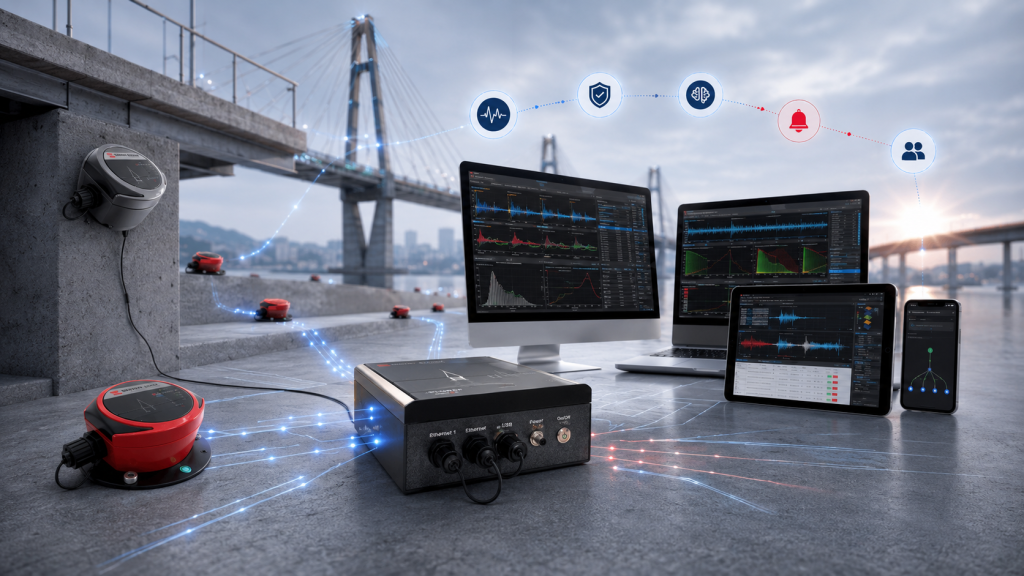
6. Digitex alarm architecture
A practical Digitex alarming system can be viewed in four layers:
Sensing: xWave, xStrain, xSense, xInc, xGeo and environmental sensors measure structural and operating conditions.
Monitoring: Voyager collects, displays and stores synchronized measurements and applies configured trigger rules.
Analysis: OMA Intelligence evaluates modal behaviour and detects persistent changes in structural characteristics.
Response: xAlarm sends notifications or activates external devices through relay outputs.
Together, these layers provide a controlled path from measurement to action, with alarms based on relevant data rather than isolated threshold exceedances.